
An excerpt from my essay "Unsettled Weather," the introduction to Nate Gowdy's award-winning monograph INSURRECTION
On the fifth anniversary of the attack on the Capitol, the line between "then" and "now" has never been clearer. Photojournalist Nate Gowdy captured it best.

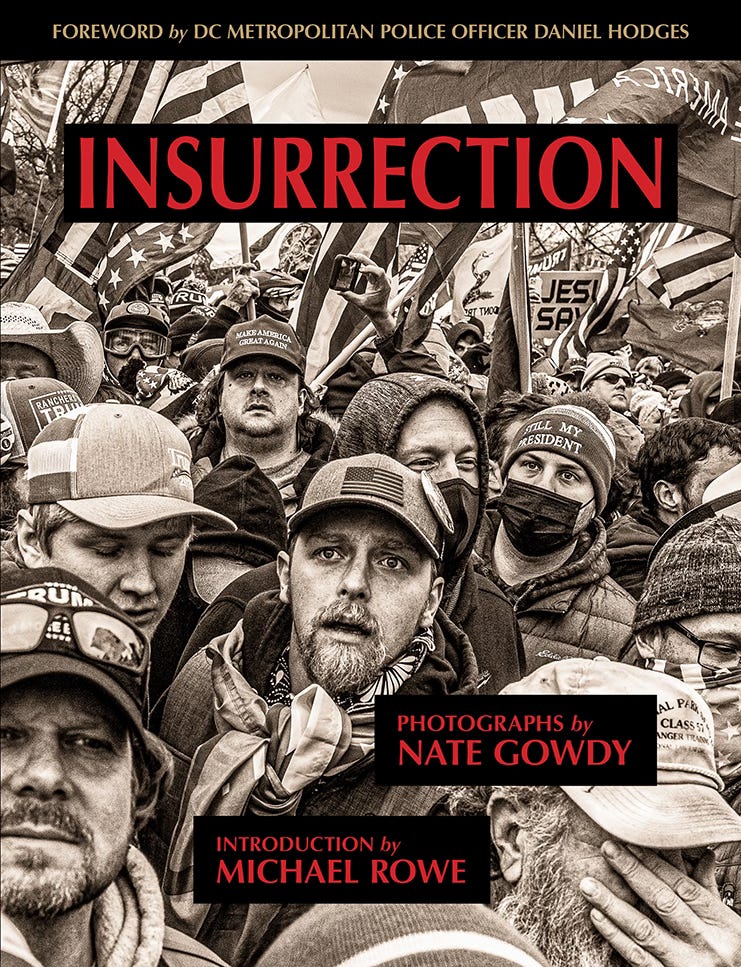
One of the great powers of art is its ability to distill even a horror like the insurrection and provide contest and distance. In this way, it can be discussed, analyzed, considered, perhaps even learned from.
In any event, it becomes an indelible part of the historical record.
It’s too easy, and far too lazy, to simply see monsters in these photographs. If there’s monstrosity—and I believe there is—it’s profoundly human monstrosity. The monstrosity is, in fact, inextricably bound to its humanity. There is something deeply immoral about pretending anything else.
Perhaps the larger question, going forward, is whether the people leafing through Nate Gowdy’s record of one of the most terrible days in America’s recent political history will allow for—let alone own—that monstrosity as part of a national identity that has always imagined itself to be the opposite of monstrous.
One scene from that day, prominently showcased in the HBO film Four Hours at the Capitol,haunts me: the sight the mob dragging Officer Mike Fanone’s prone body out of the Capitol building and down the steps, whereupon they beat him and tortured him with a taser.
The assembled men and women, some unironically brandishing “Blue Lives Matter” pro-police flags that flapped overhead in the winter wind, were unmoved by his shrieks of agony as the taser was pressed again and again to his body, including the base of his skull.
When someone screamed Kill him with his own gun! Fanone pleaded that he had kids. Only then did a few men step in to stop the torture and usher the police officer to safety.
Watching that footage, I was reminded of scenes from Iraq in 2004 and Somalia in 1993, when mobs paraded the bodies of dead Americans like gruesome spoils of war. I remembered all our collective horror and revulsion at one photograph in particular—that of the mutilated corpse of U.S. Staff Sergeant William David Cleveland being dragged by ropes through the dirt of a Mogadishu street while the crowd spit on his corpse, kicked it, and beat it with sticks.
Not for the first time that day I found myself marvelling at the savage irony of this assemblage of self-described “patriots” inadvertently recreating their own version of that grotesque tableau.
Except this time it was in the name of democracy, justice and Donald Trump; and a decorated veteran American police officer, barely alive by the end of his ordeal, was the one being dragged by a mob of his own countrymen.
Among the most noteworthy aspects of the attack on the Capitol is the quasi-religious fervor that undergirded it, and the fact that a significant number of the participants saw it as almost a holy crusade, one that carried the tacit blessing of God. This is evident, both obviously and obliquely, in many of the photographs in Insurrection.
America is unique among western nations in the historical sense of a national myth, originated by the Puritans of legend who landed at Plymouth Rock, that the country was deeded to them by divine bequest—that it was intended for those settlers and their descendants.
That stubborn streak of religiosity has persisted in the national consciousness for 245-odd years. It has taken the form of witch hunts, religious quickening, and being reinvented as political holy writ in the service of attempts to rid America of the imagined threat of socialists, communists, emancipated women, people of color, and LGBT Americans who walk proudly and with full equality in the eyes of the law.
It has survived any number of scientific and technological advances, including untold medical treatments and cures, and even space travel. It informs everything from the weather to the economy. It’s invoked at awards shows, football games, town hall meetings. At its worst, it’s essentially a dystopian fantasy of God sitting on a cloud ten miles above, say, Florida, controlling the weather and sending mobs to do His bidding.
Of late, though hardly for the first time in American history, that religiosity has settled in the breast of right-wing politics like a mote of carcinogenic dust that has since blossomed into a bruise-coloured national cancer, the lesions of which include, but are far from limited to, the events depicted here in this book.
—From INSURRECTION by Nate Gowdy; Introduction by Michael Rowe; Foreword by Daniel Hodges (Pigeon Editions, 2021 and 2023) “Unsettled Weather” © 2026 by Michael Rowe.